
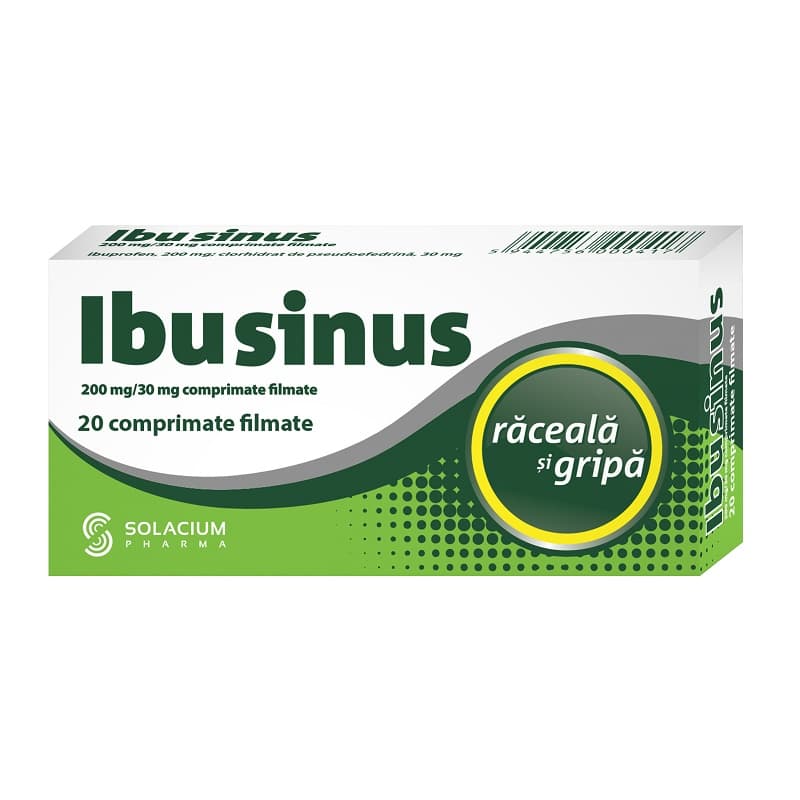
Au mai rămas ultimele bucăți
Ibusinus Răceală și Gripă este un medicament eficient sub formă de 20 de comprimate filmate, ideal pentru combaterea simptomelor neplăcute. Datorită combinației active de ibuprofen și clorhidrat de pseudoefedrină, acesta acționează rapid ca antiinflamator, analgezic și decongestionant nazal. Este recomandat adulților și adolescenților de peste 12 ani pentru ameliorarea sinuzitei, gripei și afecțiunilor respiratorii.


Descriere
Ibusinus contine doua substante active: ibuprofen 200 mg si clorhidrat de pseudoefedrina 30 mg.
Ibusinus este indicat ca antiinflamator, analgezic, antipiretic (scade febra) si decongestionant pentru caile respiratorii superioare si sinusuri la adulti si copii cu varsta peste 1512 ani. Prin cele doua substante active - ibuprofen si clorhidrat de pseudoefedrina, Ibusinus determina decongestionarea naso-sinusala si ameliorarea simptomatologiei din cadrul sinuzitelor si afectiunilor respiratorii.Se recomanda in tratamentul sinuzitelor, rinosinuzitelor, afectiunilor respiratorii si in tratamentul simptomatic al gripei.
Precautii:
Nu luati Ibusinus:
- daca sunteti alergic la ibuprofen si clorhidrat de pseudoefedrina sau la oricare dintre celelalte componente ale acestui medicament(enumerate la pct. 6);
- daca sunteti alergic la acid acetilsalicilic si alte antiinflamatoare nesteroidiene (AINS);
- daca ati avut crize de bronhospasm (senzatie de lipsa de aer, respiratie suieratoare si scurtata), rinita, urticarie sau angioedem (umflare a fetei, a limbii sau a gatului - laringelui - care poate determina dificultati in respiratie) la acid acetilsalicilic sau la alte antiinflamatoare nesteroidiene;
- daca ati avut ulcer sau sangerare la nivelul stomacului sau intestinului subtire (duoden) legate de utilizarea anterioara a medicamentelor pentru durere si inflamatie (AINS) ;
- daca aveti ulcer sau sangerare la nivelul stomacului sau intestinului subtire (duoden) sau daca ati avut doua sau mai multe astfel de episoade in trecut;
- daca aveti afectare severa (insuficienta severa) a ficatului, rinichilor sau inimii;
- daca aveti boala cardiaca coronariana;
- daca aveti orice sangerare activa (inclusiv la nivelul creierului);
- daca aveti o afectiune de origine necunoscuta avand ca rezultat formarea anormala a celulelor sanguine;
- daca aveti tensiune arteriala crescuta mult peste limitele normale sau necontrolata cu tratament adecvat;
- daca aveti angina pectorala (durere toracica);
- daca aveti diabet zaharat;
- daca aveti feocromocitom;
- daca aveti o crestere a activitatii glandei tiroide (hipertiroidie);
- daca aveti o forma de glaucom cu unghi inchis;
- daca aveti hiperplazie de prostata;
- daca aveti epilepsie;
- daca urmati tratament cu unele antidepresive (denumite antidepresive triciclice si inhibitori de monooaminoxidaza) sau daca ati intrerupt tratamentul cu aceste medicamente de mai putin de 2 saptamani;
- daca aveti varsta sub 1512 ani si greutatea sub 40 kg;
- daca sunteti gravida sau alaptati.
Inainte sa luati Ibusinus, adresati-va medicului dumneavoastra sau farmacistului daca:
- aveti lupus eritematos sistemic (LES) sau alte afectiuni autoimune (boala mixta a tesutului conjunctiv);
- exista in familie o tulburare in producerea pigmentului rosu din sange (porfirie);
- suferiti de alcoolism;
- aveti obstructie piloro-duodenala (ingustarea pana la blocare a legaturii dintre stomac si intestinul subtire);
- aveti afectiuni intestinale inflamatorii cronice, cum sunt inflamatia colonului cu leziuni ulceroase (rectocolita ulcerohemoragica), o inflamatie care afecteaza tractul digestiv (boala Crohn) sau alte afectiuni ale stomacului sau intestinului;
- aveti insuficienta cardiaca si tensiune arteriala crescuta;
- aveti tulburari hepatice si renale;
- aveti tulburari de formare a celulelor sanguine;
- aveti probleme legate de coagularea sangelui;
- aveti alergii, rinita alergica, sezoniera (febra fanului), astm bronsic, inflamare cronica a mucoasei nazale si a sinusurilor, polipi nazali sau afectiuni obstructive cronice ale tractului respirator, deoarece riscul de urticarie, angioedem si bronhospasm este mai mare;- ati avut recent o interventie chirurgicala majora.
Copii si adolescenti
Exista risc de aparitie a insuficientei renale la copiii si adolescentii care sufera de deshidratare.
Varstnici
Daca sunteti in varsta veti fi mai expus la reactii adverse, in special sangerare si perforatie la nivelul tractului digestiv care pot duce la deces.
Ulcere, perforatie si sangerare la nivelul stomacului sau intestinelor
- Daca ati avut anterior ulcer la nivelul stomacului sau intestinelor, in special daca acesta a fost complicat cu perforatie sau a fost insotit de sangerare, trebuie sa fiti atent la orice simptome abdominale neobisnuite si sa spuneti imediat medicului dumneavoastra, mai ales daca aceste simptome apar la inceputul tratamentului. Acest lucru este necesar deoarece riscul de sangerare sau de ulceratie la nivelul tractului digestiv este mai mare in acest caz, in special la pacientii varstnici. Daca apare sangerare sau ulceratie la nivelul tractului digestiv, tratamentul trebuie intrerupt. Sangerarea, ulceratia sau perforatia la nivelul stomacului sau intestinelor pot aparea fara alte semne de avertizare, chiar si la pacientii care nu au avut niciodata astfel de probleme. Acestea pot duce, de asemenea, la deces.
- Riscul de aparitie a ulcerelor, perforatiei sau sangerarii la nivelul stomacului sau intestinelor creste la doze mari de ibuprofen. Riscul este crescut la persane in varsta, la persoane cu numeroase afectiuni, la cei cu greutate corporala mica sau care consuma bauturi alcoolice. Riscul creste, de asemenea, daca anumite medicamente sunt luate in acelasi timp cu ibuprofenul (vezi mai jos, Ibusinus impreuna cu alte medicamente).
Efecte asupra inimii si creierului
Medicamentele anti-inflamatoare/impotriva durerii, cum este ibuprofenul, pot fi asociate cu un risc usor crescut de infarct miocardic sau accident vascular cerebral, in special daca sunt utilizate in doze mari. Nu depasiti doza recomandata sau durata tratamentului.
Trebuie sa discutati despre tratament cu medicul dumneavoastra sau cu farmacistul, inainte de a lua Ibusinus in cazul in care:
- aveti probleme ale inimii, inclusiv insuficienta cardiaca, angina pectorala (dureri in piept) sau daca ati avut un infarct miocardic, interventie chirurgicala pentru by-pass, boala arteriala periferica (circulatie redusa a sangelui la nivelul picioarelor sau talpilor, din cauza ingustarii sau blocarii arterelor) sau orice tip de accident vascular cerebral (inclusiv „accident vascular cerebral minor” sau accident ischemic tranzitoriu „AIT”).
- aveti tensiune arteriala mare, diabet zaharat, concentratii crescute de colesterol in sange, istoric familial de boli ale inimii sau accident vascular cerebral sau daca sunteti fumator.
Reactii la nivelul pielii
Trebuie sa incetati a mai lua ibuprofen la primul semn de eruptie trecatoare pe piele, leziuni la nivelul mucoaselor sau alte semne de alergie deoarece acestea pot fi primul semn al unor reactii adverse grave la nivelul pielii (dermatita exfoliativa, eritem polimorf, sindrom Stevens-Johnson) care pot duce uneori la deces. Cel mai mare risc al aparitiei acestor reactii este in prima luna de tratament.
In timpul varicelei, se recomanda sa evitati utilizarea acestui medicament.
Efecte asupra rinichilor
Ibusinus poate determina probleme in functionarea rinichilor, chiar si la pacientii care nu au mai avut astfel de afectiuni. Aceste probleme pot determina umflarea picioarelor si pot conduce chiar la afectiune severa a inimii sau valori ale tensiunii arteriale persistent marite la persoanele predispuse. Ibusinus poate determina leziuni ale rinichilor, in special la pacientii care deja au avut probleme la nivelul rinichilor, inimii sau ficatului, sunt in tratament cu anumite medicamente (diuretice sau inhibitori ai ECA), precum si la varstnici. Este necesar ca medicul dumneavoastra sa va urmareasca functia rinichilor. In general, intreruperea tratamentului cu ibuprofen conduce la vindecare.
Alte precautii:
- In tratamentul de lunga durata, la utilizarea de doze mari de analgezice, poate sa apara durerea de cap care nu trebuie tratata prin cresterea dozelor din acest medicament.
- Utilizarea obisnuita pe perioade lungi de timp a analgezicelor poate determina leziuni renale permanente si risc de insuficienta renala. Acest risc poate creste in conditii de solicitare fizica, asociata cu pierdere a sarurilor si deshidratare.
- Ibusinus poate masca simptomele sau semnele unei infectii (febra, durere si inflamatie); de asemenea poate prelungi temporar timpul de sangerare. Medicul dumneavoastra va va urmari functia ficatului si analizele sangelui.
- Pe durata tratamentului cu Ibusinus, anumite cazuri cu simptome de meningita aseptica, cum sunt intepenire a cefei, durere de cap, greata, varsaturi, febra sau dezorientare au fost observate la pacientii cu anumite boli autoimune (cum sunt lupusul eritematos sistemic, boala mixta a tesutului conjunctiv).
- Consumul de alcool trebuie evitat intrucat acesta poate accentua reactiile adverse ale ibuprofenului ca si a altor medicamente antiinflamatoare, in special daca acestea afecteaza tractul gastro-intestinal sau creierul.
- In cazul aparitiei tulburarilor de vedere (inclusiv in situatia in care aveti glaucom) trebuie sa va adresati medicului, sa intrerupeti tratamentul cu ibuprofen si se recomanda efectuarea unui control oftalmologic.
- Ibusinus poate reduce posibilitatea de a ramane gravida. Trebuie sa discutati cu medicul dumneavoastra daca planificati sa ramaneti gravida sau daca aveti probleme in a ramane gravida.
- Sportivii de performanta trebuie avertizati ca pseudoefedrina poate determina pozitivarea testelor.
- Poate avea loc reducerea fluxului sanguin la nervul optic in timpul administrarii Ibusinus. Daca apare pierderea brusca a vederii, intrerupeti administrarea Ibusinus si contactati-va medicul sau solicitati imediat asistenta medicala. Vezi pct. 4.
Ibusinus impreuna cu alte medicamente
Spuneti medicului dumneavoastra sau farmacistului daca luati, ati luat recent sau s-ar putea sa luati orice alte medicamente. Ibusinus poate influenta sau poate fi influentat de alte medicamente. De exemplu:
- alte antiinflamatoare nesteroidiene (AINS)
- acid acetilsalicilic
- anticoagulante (impotriva coagularii sangelui), cum este warfarina sau heparina
- antiagregante plachetare (impotriva coagularii sangelui), cum este ticlopidina sau clopidogrelul
- metotrexat (utilizat in tratamentul cancerului si afectiunilor autoimune)
- chinidina, glicozide digitalice, de exemplu digoxina (pentru tratamentul diferitelor afectiuni ale inimii)
- fenitoina (utilizata pentru a preveni aparitia convulsiilor epileptice)
- litiu (utilizat in tratamentul depresiei si maniei)
- diuretice (pentru eliminarea apei), incluzand cele care economisesc potasiu
- antihipertensive (pentru tratamentul valorilor tensiunii arteriale persistent marite), cum sunt:
- • inhibitori ai ECA, de exemplu, captopril
- • medicamente beta blocante
- • antagonisti de angiotensina II
- colestiramina (utilizata in tratamentul valorilor mari ale colesterolului)
- aminoglicozide (medicamente impotriva anumitor tipuri de bacterii)
- ISRS (medicamente impotriva depresiei), cum sunt paroxetina, sertralina, citalopramul
- moclobemida (IMAO selectiv si reversibil – un medicament utilizat in tratamentul bolilor depresive sau fobiilor sociale)
- ciclosporina, tacrolimus (pentru inhibarea sistemul imunitar dupa transplantul de organe)
- zidovudina sau ritonavir (utilizat in tratamentul infectiilor cu HIV)
- mifepristona
- probenecid sau sulfinpirazona (pentru tratamentul gutei)
- antibiotice chinolone
- sulfoniluree (pentru tratamentul diabetului zaharat de tip 2)
- corticosteroizi (utilizati impotriva inflamatiilor)
- bifosfonati (utilizati in osteoporoza, boala Paget si pentru a reduce valorile mari ale calciului din sange)
- pentoxifilina (utilizata in tratamentul afectiunii circulatorii ale arterelor picioarelor sau bratelor)
- baclofen (un relaxant pentru muschi)
- trimetoprim
- simpatomimetice, de exemplu decongestionante sau medicamente care scad apetitul alimentar.
- simpatolitice, de exemplu bretilium, betanidina, guanetidina, debrisoquina, metildopa, rezerpina
- medicamente blocante α- si β- adrenergice
- antidepresivele triciclice si cele numite IMAO
- unele anestezice generale (volatile halogenate).
Ibusinus impreuna cu alimente, bauturi si alcool
- Luati Ibusinus cu un pahar de apa in timpul mesei sau dupa masa.
- Evitati alcoolul etilic, deoarece acesta accentueaza reactiile adverse la Ibusinus, in special pe acelea care afecteaza stomacul, intestinele sau creierul.
- Sarcina, alaptarea si fertilitatea
- Daca sunteti gravida sau alaptati, credeti ca ati putea fi gravida sau intentionati sa ramaneti gravida, adresati-va medicului sau farmacistului pentru recomandari inainte de a lua acest medicament.
- Nu luati Ibusinus daca sunteti gravida sau alaptati.
- Ibusinus contine ibuprofen care apartine unei grupe de medicamente (AINS) ce poate afecta fertilitatea la femei. Acest efect este reversibil la intreruperea administrarii medicamentului.
Conducerea vehiculelor si folosirea utilajelor
In general, Ibusinus nu are reactii adverse asupra capacitatii de a conduce vehicule sau de a folosi utilaje.
Cu toate acestea, la doze mari, in cazuri individuale, pot aparea reactii adverse, cum sunt oboseala, somnolenta, vertij si tulburari de vedere (raportate ca mai putin frecvente); de aceea, ar putea fi influentate negativ activitatile ce necesita atentie sporita, coordonare motorie si decizii rapide (de exemplu lucrul la inaltime, capacitatea de a conduce vehicule si de a folosi utilaje). Acest efect este potentat in cazul consumului concomitent de alcool.
Reactii adverse posibile:
Ca toate medicamentele, acest medicament poate provoca reactii adverse, cu toate ca nu apar la toate persoanele.
Medicamente precum Ibusinus se pot asocia cu un risc usor crescut de aparitie a atacului de cord („infarct miocardic”) sau a accidentului vascular cerebral.
Posibilitatea de aparitie a reactiilor adverse creste la doze mai mari si la o durata mai lunga de tratament.
Urmatoarele reactii adverse sunt importante si necesita interventie imediata, daca apar. Trebuie sa incetati sa luati Ibusinus si sa va adresati imediat medicului dumneavoastra daca apar urmatoarele simptome:
Frecvente (care afecteaza mai putin de 1 din 10 pacienti ):
- scaune de culoarea pacurii sau varsaturi cu sange (ulcer la nivelul tractului digestiv cu sangerare)
Foarte rare (care afecteaza mai putin de 1 din 10000 pacienti ):
- umflare a fetei, a limbii sau a gatului (laringe) care poate determina dificultati in respiratie (edem angioneurotic), batai rapide ale inimii, scadere severa a tensiunii arteriale sau soc cu potential letal
- reactie alergica brusca cu scurtarea respiratiei, respiratie suieratoare si scaderea tensiunii arteriale
- eruptie severa pe piele cu vezicule, in special pe picioare, brate, palme si talpi care pot implica si fata si buzele (eritem polimorf, sindrom Stevens-Johnson). Acestea se pot agrava si mai mult, veziculele se pot largi si extinde si parti ale pielii se pot coji (sindromul Lyell). De asemenea, poate exista o infectie severa cu distrugerea pielii (necroza), a tesutului subcutanat si muschilor.
Trebuie sa incetati sa luati medicamentul si sa va adresati medicului dumneavoastra cat mai repede posibil daca manifestati urmatoarele reactii adverse:
Foarte frecvente (care afecteaza mai mult de 1 pacient din 10 ):
- senzatie de arsura in capul pieptului, durere abdominala, indigestie
Mai putin frecvente (care afecteaza mai putin de 1 din 100 pacienti ):
- vedere incetosata sau alte probleme de vedere, cum este sensibilitatea la lumina
- reactii de hipersensibilitate, cum sunt eruptia trecatoare pe piele, mancarimea, criza de astm bronsic (uneori cu tensiune arteriala mica)
Rare (care afecteaza mai putin de 1 din 1000 pacienti ):
- pierdere a vederii
Foarte rare (care afecteaza mai putin de 1 din 10000 pacienti ):
- umplere brusca a plamanilor cu apa avand ca rezultat dificultati in respiratie, tensiune arteriala mare, retentie de apa si crestere in greutate
Alte reactii adverse posibile la Ibusinus sunt:
Foarte frecvente (care afecteaza mai mult de 1 pacient din 10 ):
- tulburari la nivelul tractului digestiv, cum sunt diaree, greata, varsaturi, balonare, constipatie
Frecvente (care afecteaza mai putin de 1 din 10 pacienti ):
- ulcer la nivelul tractului digestiv cu sau fara perforatie
- inflamatie a intestinului si agravare a inflamatiei colonului (colita) si a tractului digestiv (boala Crohn) si complicatii ale diverticulitei de la nivelul intestinului gros (perforatie sau fistula)
- sangerare microscopica intestinala care poate conduce la anemie
- ulcere la nivelul gurii si inflamatie
- durere de cap, somnolenta, vertij, ameteli, oboseala, agitatie, insomnie si iritabilitate
Mai putin frecvente (care afecteaza mai putin de 1 din 100 pacienti ):
- inflamatie a mucoasei stomacului
- probleme renale, incluzand formare de edem, inflamatie a rinichilor si insuficienta renala
- secretii nazale
- dificultati in respiratie (bronhospasm)
Rare (care afecteaza mai putin de 1 din 1000 pacienti ):
- depresie, confuzie, halucinatii
- sindrom de lupus eritematos
- crestere a azotului ureic din sange si a altor valori serice ale enzimelor ficatului, scadere a valorilor hemoglobinei si ale hematocritului, inhibare a agregarii plachetelor si timp de sangerare prelungit, scadere a calciului din sange si crestere a valorilor acidului uric din sange.
- oligurie, distrugere a tesutului renal (care poate duce la insuficienta renala si concentratii plasmatice mari ale acidului uric.
Foarte rare (care afecteaza mai putin de 1 din 10000 pacienti ):
- percepere neplacuta a batailor inimii, insuficienta cardiaca, infarct miocardic sau tensiune arteriala mare
- tulburari de formare a celulelor sanguine (cu simptome precum: febra, durere in gat, ulcere la nivelul suprafetei gurii, simptome de gripa, oboseala severa, sangerare la nivelul pielii si nasului)
- tiuituri si vajaituri in urechi
- inflamatie a esofagului sau a pancreasului
- ingustare a lumenului intestinal
- inflamatie acuta a ficatului, colorare in galben a pielii sau a albului ochilor, disfunctie, leziune sau insuficienta hepatica
- inflamatie a membranei creierului (fara infectie bacteriana)
- lezare a tesutului rinichilor
- cadere a parului
Cu frecventa necunoscuta (care nu poate fi estimata din datele disponibile)
- flux sanguin redus la nervul optic (neuropatie optica ischemica).
Ibusinus poate determina scaderea numarului de globule albe si a rezistentei dumneavoastra la infectii. Daca prezentati o infectie cu febra si deteriorare grava a starii generale sau febra cu simptome de infectie locala, cum sunt durere in gat/faringe/gura sau probleme urinare, trebuie sa va prezentati imediat la medicul dumneavoastra. Vi se va face un test sanguin pentru a investiga o posibila scadere a numarului de globule albe (agranulocitoza).
In timpul tratamentului cu ibuprofen, cazuri rare de meningita (manifestate prin rigiditate a gatului, durere de cap, greata, varsaturi, febra sau dezorientare) au fost observate la pacientii cu tulburari autoimune existente, cum este lupusul eritematos sistemic sau boala mixta a tesutului conjunctiv.
Utilizarea ibuprofenului in timpul varicelei, in cazuri exceptionale, poate sa determine aparitia unor infectii grave ale pielii si complicatii la nivelul tesuturilor moi.
Raportarea reactiilor adverse
Ingrediente:
ibuprofen/clorhidrat de pseudoefedrina
Mod de administrare:
Acest supliment alimentar nu se utilizeaza pentru mai mult de 7 zile consecutiv fara sfatul medicului deoarece exista riscul crearii dependentei.
Luati intotdeauna acest medicament exact asa cum este descris in acest prospect sau asa cum v-a spus medicul dumneavoastra sau farmacistul. Discutati cu medicul sau cu farmacistul daca nu sunteti sigur.
Doze
Adulti si copii in varsta de si peste 12 ani:
Doza initiala recomandata este de 1-2 comprimate filmate.
Daca este necesar, tratamentul se va continua cu 1-2 comprimate filmate la fiecare 4-6 ore. Nu trebuie depasita o doza zilnica maxima de 6 comprimate filmate (echivalent cu 1200 mg ibuprofen si 180 mg clorhidrat de pseudoefedrina).
Nu trebuie administrat la copii cu varsta sub 12 ani.
Daca este necesar ca acest medicament sa fie administrat mai mult de 3 zile pentru febra sau mai mult de 4 zile pentru calmarea durerilor sau daca simptomele se agraveaza sau persista, trebuie sa va adresati unui medic pentru reevaluarea diagnosticului si tratamentului.
Se recomanda ca pacientii cu tulburari dispeptice sa utilizeze Ibusinus impreuna cu alimente.
Varstnici:
Daca sunteti in varsta veti fi mai predispusi la reactii adverse, in special la hemoragie si perforatie la nivelul tractului digestiv, care pot duce la deces. Asadar adresati-va medicului dumneavoastra pentru recomandari.
Insuficienta renala sau hepatica: daca aveti insuficienta renala sau hepatica adresati-va medicului dumneavoastra pentru recomandari.
Reactiile adverse pot fi reduse la minimum prin administrarea celei mai mici doze eficace pentru cea mai scurta perioada necesara controlarii simptomelor.
Daca luati mai mult Ibusinus decat trebuie
Daca dumneavoastra (sau altcineva) ati luat accidental prea multe comprimate de Ibusinus, adresati-va imediat medicului dumneavoastra sau mergeti la cel mai apropiat spital. Luati acest prospect cu dumneavoastra si cutia pentru ca medicul sa stie ce medicament si cate comprimate filmate ati luat.
Simptomele unui supradozaj pot fi: greata, varsaturi, durere de stomac si semne de sangerare digestiva. De asemenea, pot aparea tiuituri in urechi, durere de cap, ameteli, vertij, lipsa de concentrare. In cazuri grave poate aparea somnolenta, stare de agitatie, insomnie, dezorientare, tremor, coma, convulsii, crampe (in special la copii), probleme de vedere, insuficienta renala, leziuni la nivelul ficatului, tensiune arteriala anormal scazuta sau crescuta, tulburari ale batailor inimii, respiratie redusa, colorarea in albastru a buzelor, a limbii si a degetelor si cresterea tendintei de sangerare, senzatie de sete cu consum crescut de lichide si transpiratie abundenta, dificultati la urinare. De asemenea, poate aparea agravarea astmului bronsic la pacientii cu astm bronsic.
Daca uitati sa luati Ibusinus
Daca ati uitat sa luati o doza, luati-o cat mai repede posibil, cu exceptia cazului in care au ramas mai putin de patru ore pana la urmatoarea doza.
Nu luati o doza dubla pentru a compensa doza uitata.
Daca aveti orice intrebari suplimentare cu privire la acest medicament adresati-va medicului dumneavoastra sau farmacistului.
- Ibusinus contine lactoza.
- Daca medicul dumneavoastra v-a atentionat ca aveti intoleranta la unele categorii de glucide, va rugam sa-l intrebati inainte de a lua acest medicament.
Ingrediente & Alergeni
Ingrediente
: Ibuprofen, pseudoefedrina